
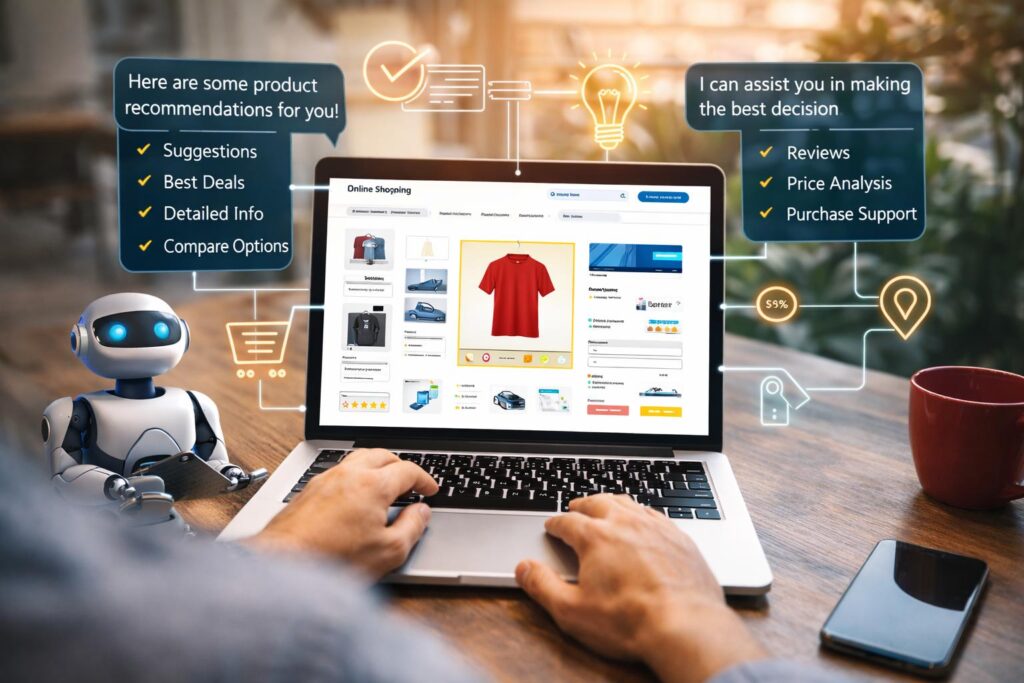
Imagine telling an AI assistant what you want to buy, explaining your budget and preferences, and letting it search through thousands of products, compare options and help you make a purchase. You don’t visit an online marketplace, scroll through sponsored listings or spend time comparing product pages. Your AI assistant does much of that work for you.
This may sound like a convenient shopping experience. But for companies that have built their businesses around online product discovery and advertising, it raises some uncomfortable questions.
A recent report about Amazon and Meta offers an interesting glimpse into this emerging tension.
According to Fortune’s report published on November 25, 2026, the two companies are discussing a possible arrangement that would allow Meta’s Muse AI agent to access Amazon’s marketplace again. Amazon had blocked the agent in September. The discussions reportedly involve product search results, advertising and how the companies would manage the relationship with shoppers. No agreement has been announced, and the outcome remains uncertain.
The development is worth watching because it highlights a much bigger shift in how people may discover and purchase products.
The shopping journey may no longer begin with a search bar
For years, online shopping has followed a fairly familiar pattern.
A consumer visits a marketplace, searches for a product, compares listings, reads reviews, sees sponsored recommendations and eventually makes a purchase.
The marketplace controls much of this journey. It decides how products are displayed, which results appear prominently and where advertisements are placed.
AI shopping agents could change this arrangement.
Instead of navigating a marketplace themselves, consumers may increasingly delegate product discovery to an AI assistant. They might ask it to find a laptop under a certain budget, compare specifications, identify reliable sellers and recommend the most suitable option.
The assistant becomes an intermediary between the consumer and the retailer.
This is where things get interesting for businesses.
If an AI agent makes the selection and presents only a handful of recommendations, the retailer may lose some control over how products are discovered. The consumer may never see the marketplace’s full search results or the advertisements displayed alongside them.
Why Amazon has reasons to be cautious
Advertising is an important part of Amazon’s business. Fortune reports that Amazon’s advertising business generates approximately $68.6 billion, making it a significant revenue stream.
An external AI agent that helps consumers shop without navigating Amazon’s website could potentially bypass some of the advertising opportunities that Amazon has built its business around.
There are other concerns too.
Amazon reportedly wants to maintain control over the quality of product search results surfaced by an external agent. It also has an interest in preserving its direct relationship with customers.
Think about what happens when a customer delegates shopping to an AI assistant. Who decides which products are recommended? Who gets credit for the sale? Who handles a poor recommendation or an incorrect purchase? And who owns the customer relationship?
These are not merely technical integration questions. They involve revenue, customer experience, data and business strategy.
The battle is about who controls product discovery
Meta has a different incentive.
The more useful Muse becomes, the more likely consumers are to rely on it for everyday tasks, including shopping. Access to large retail marketplaces would make the assistant considerably more useful.
This creates an interesting commercial relationship.
Retailers want customers to discover and purchase products through their own platforms. AI companies want their assistants to become the preferred starting point for consumer decisions.
Both sides need each other, but neither necessarily wants to give up control.
This is not entirely new. Businesses have always competed to own the customer relationship. What is changing is the intermediary through which that relationship may be managed.
What this means for businesses and brands
The implications extend well beyond Amazon and Meta.
If AI agents become a common way to discover products, businesses may need to rethink how their products are presented and found online.
A product listing designed to attract a human shopper through photographs, promotional banners and persuasive descriptions may not be enough for an AI agent evaluating specifications, price, availability, reviews and suitability.
Businesses may increasingly need to make product information accurate, structured and accessible to systems that can interpret it.
Advertising could also evolve. If consumers increasingly rely on AI-generated recommendations instead of browsing search results, brands will have to understand how visibility and sponsored placements work in these new environments.
There is also an important question of trust. Consumers will need to know whether an AI assistant is recommending a product. After all, it genuinely matches their requirements because it is sponsored, or because of a commercial arrangement they cannot easily see.
Convenience should not come at the cost of transparency.
Are we moving towards agentic commerce?
This emerging model is often described as agentic commerce: AI systems that can assist with or carry out parts of the buying process on behalf of consumers.
It is still an evolving space. The reliability of recommendations, payment authorisation, privacy, security, accountability and consumer trust will all influence how quickly it becomes mainstream.
The reported Amazon-Meta discussions are therefore significant even if they do not result in an agreement. They illustrate the commercial questions that arise when AI agents begin interacting directly with established digital platforms.
Final thoughts
The most interesting aspect of this development is not whether Amazon eventually allows Muse to access its marketplace.
It is the possibility that the traditional relationship between consumers, retailers and digital platforms is beginning to change.
For years, businesses have competed to attract consumers to their websites and apps. In an AI-driven shopping environment, they may increasingly have to compete for the attention and recommendations of the assistants acting on behalf of those consumers.
The next major battle in e-commerce may not be about who owns the biggest marketplace. It may be about who influences the AI that decides what consumers buy.





Leave a Reply